
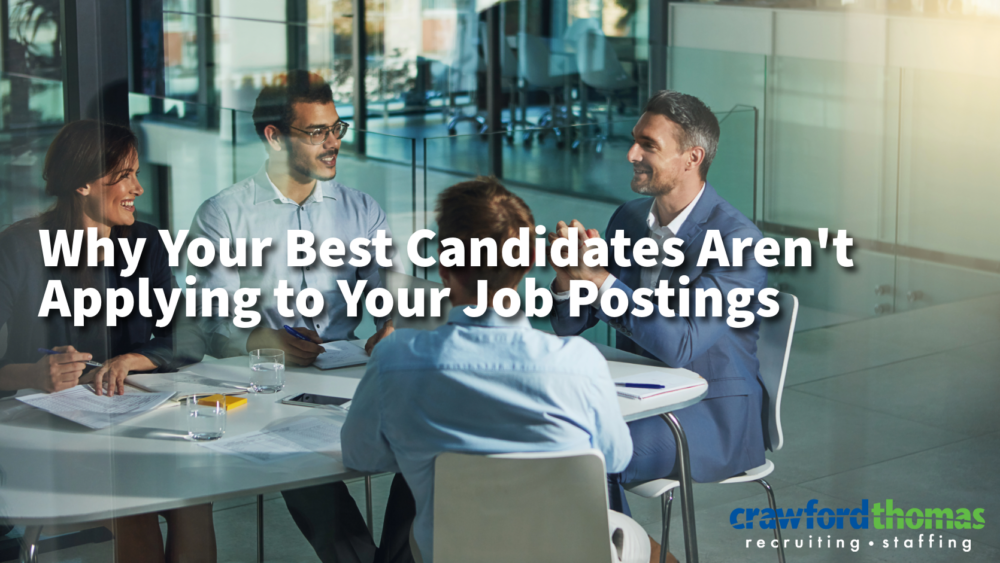
Your next great hire might not be looking for a job. Here’s why proactive recruiting matters more than simply posting an opening.
You’ve written the job description, posted the position on LinkedIn and Indeed, and waited for applications to roll in.
A few days later, you’ve received plenty of resumes. But there’s a problem: the candidates you really want aren’t applying.
Sound familiar?
This is a common challenge for hiring managers and talent acquisition teams. While online job postings are an important part of recruiting, they don’t always reach the qualified professionals who could make the biggest impact on your business.
That’s where passive candidate recruiting comes into play.
At Crawford Thomas Recruiting, we understand that finding the right employee often requires more than waiting for applications. Sometimes, the best candidates are the ones who aren’t actively looking for a new job.

Why Aren’t Qualified Candidates Applying to Your Jobs?
The short answer: Many qualified professionals are already employed, aren’t actively searching job boards, or simply haven’t come across your opportunity.
Others may be open to a career move but need a compelling reason to consider leaving their current employer.
This means your ideal candidate could be out there right now, performing exceptionally well in a similar position, without ever seeing your job posting.
Here are six reasons why great candidates may not be applying and what employers can do about it.
1. The Best Candidates May Already Have a Job
Not every qualified professional is actively searching for employment.
Many experienced employees are comfortable in their current positions. They’re earning a steady paycheck, building relationships, and focusing on their responsibilities.
That doesn’t necessarily mean they’re unwilling to consider something better.
A stronger career path, more competitive compensation, better leadership, or an exciting new challenge could convince them to explore another opportunity.
The challenge? They may never visit a job board to discover your opening.
This is one of the biggest reasons companies benefit from working with professional recruiters.
Rather than relying exclusively on incoming applications, recruiters proactively identify and contact professionals whose experience aligns with an employer’s needs.
2. Your Job Posting Isn’t Reaching the Right Audience
Publishing a position online doesn’t guarantee that qualified candidates will see it.
Job boards are crowded, and candidates have countless opportunities competing for their attention.
Even a well-written job description can get overlooked if it isn’t reaching the right professionals.
Several factors can limit visibility:
- Job titles that don’t match common candidate searches.
- Unclear location or remote-work expectations.
- Missing compensation information.
- Job descriptions that are too long or difficult to scan.
- Limited distribution across relevant recruiting channels.
What can employers do?
Start by reviewing how your job postings appear to candidates.
Use recognizable job titles, clearly communicate the position’s benefits, and make the most important details easy to find.
But remember, improving your posting is only part of the solution. Proactive candidate outreach can help you connect with professionals who aren’t searching at all.
3. Your Job Requirements May Be Too Restrictive
Every hiring manager wants a qualified candidate.
But sometimes, the list of requirements becomes so specific that potentially excellent employees decide not to apply.
For example, a company might request:
- Seven years of industry experience.
- Experience with several specific software platforms.
- A particular degree or certification.
- Previous experience in an identical position.
- Familiarity with a highly specialized market.
Some of these qualifications may be essential. Others might simply be preferences.
The problem arises when candidates assume they must meet every requirement to be considered.
A professional who meets 80% of your requirements could still be an excellent hire, particularly when they bring transferable skills, strong accomplishments, and the ability to learn.
Hiring managers should work with their recruiting teams to distinguish between must-have qualifications and skills that can be developed after hiring.
This creates a larger, more realistic pool of qualified candidates without sacrificing hiring standards.
4. Your Opportunity Doesn’t Give Candidates a Reason to Leave
Think about your job posting from the perspective of someone who’s already employed.
Why should they leave their current company to join yours?
If your description focuses entirely on responsibilities and requirements, you may be missing an opportunity to explain what makes the position attractive.
Qualified professionals often want to understand:
- What career growth looks like.
- How competitive the compensation package is.
- What makes the company culture different.
- Whether leadership supports employee development.
- What opportunities exist for advancement.
- How the role fits their long-term career goals.
Your job posting should sell the opportunity, not just describe the responsibilities.
And when recruiting passive candidates, this becomes even more important.
A recruiter can have a personalized conversation about what motivates a professional and explain why a particular opportunity might be worth exploring.
That’s difficult to accomplish through a job posting alone.
5. Your Hiring Process May Be Turning Candidates Away
Sometimes, qualified candidates do find your job posting but decide the application process isn’t worth the effort.
Lengthy applications, repetitive questions, unclear compensation, and unnecessary steps can discourage interested professionals.
And if your hiring process moves too slowly, candidates who initially expressed interest may pursue other opportunities.
Consider the experience you’re creating.
Can someone easily apply from their phone? Do they understand the position before submitting their resume? Are interview timelines reasonable? Is your team communicating consistently?
A great candidate experience starts before the first interview.
Making the application process easier and keeping candidates informed can help employers maintain interest throughout the hiring process.
6. You’re Waiting for Candidates Instead of Recruiting Them
There’s an important difference between posting a job and actively recruiting.
Posting a job creates an opportunity for candidates to find you.
Recruiting means identifying the professionals you want to hire and starting conversations with them.
Both approaches have value, but relying exclusively on applications can limit your reach.
Proactive recruiting may include:
- Identifying professionals at companies within your industry.
- Reaching out to qualified passive candidates.
- Building relationships with professionals who aren’t actively searching.
- Networking within specialized industries.
- Maintaining candidate pipelines for future opportunities.
- Evaluating experience, career goals, and compensation expectations before presenting candidates.
Instead of waiting for the right person to discover your opening, proactive recruiting helps bring your opportunity directly to them.
How Crawford Thomas Recruiting Helps You Reach Candidates Who Aren’t Applying
At Crawford Thomas Recruiting, we do more than advertise open positions.
Our recruiters work directly with employers to understand what they’re looking for, including the skills, experience, qualifications, and professional qualities that matter most.
Then we go to work finding those candidates.
Here’s how we help companies expand their reach:
Proactive Candidate Sourcing
We identify and connect with qualified professionals, including passive candidates who may not be actively applying for jobs.
Candidate Screening and Evaluation
Our recruiters evaluate professional experience, qualifications, career interests, and compensation expectations before presenting candidates to hiring managers.
Job Marketing and Promotion
We help promote open opportunities through online recruiting channels while also using direct outreach to connect with qualified talent.
Specialized Recruiting Expertise
Our team supports employers across multiple industries, including sales, marketing, IT, engineering, finance, accounting, legal, construction, healthcare, and executive leadership.
Support for Internal Talent Acquisition Teams
Already have an internal recruiting department? Great.
We work alongside existing talent acquisition teams, providing additional sourcing capabilities and recruiting support when companies need it.
Contingency-Based Recruiting
With our contingency recruiting model, employers pay nothing until they make a successful hire.
Whether you’re filling a difficult position or simply looking to reach candidates outside your usual applicant pool, our team can help.
Frequently Asked Questions About Passive Candidate Recruiting
What is a passive candidate?
A passive candidate is a professional who isn’t actively searching for a new job but may be open to considering the right opportunity. These individuals are often employed and may need personalized outreach to learn about available positions.
Why aren’t qualified candidates applying to job postings?
Qualified candidates may already be employed, may not use job boards regularly, or may not see enough value in an advertised opportunity to apply. Restrictive job requirements and complicated application processes can also discourage applicants.
How do recruiters find passive candidates?
Professional recruiters use sourcing tools, professional networks, industry research, referrals, and direct outreach to identify and connect with qualified individuals who may not be actively searching for employment.
Is it better to post a job or use a recruiting firm?
Both approaches can be valuable. Job postings help attract active job seekers, while recruiting firms can expand your reach by proactively contacting qualified professionals. Combining both methods can create a more comprehensive hiring strategy.
Can a recruiting firm work with an internal HR or talent acquisition team?
Absolutely. Recruiting firms like Crawford Thomas Recruiting can work alongside internal hiring teams, providing additional sourcing, screening, and recruiting support without replacing existing staff.
Stop Waiting for the Right Candidate to Find You
Your next great employee might not be refreshing LinkedIn, browsing job boards, or submitting applications.
They might already be working somewhere else, doing an excellent job, and waiting for the right opportunity to come along.
That’s why companies shouldn’t rely exclusively on job postings to attract qualified talent.
A successful hiring strategy combines strong job advertising, a positive candidate experience, realistic requirements, and proactive recruiting.
At Crawford Thomas Recruiting, we help employers reach the qualified professionals they might otherwise miss.
If your job postings aren’t bringing in the candidates you need, it may be time to take a more proactive approach.
Let’s find your next great hire.