
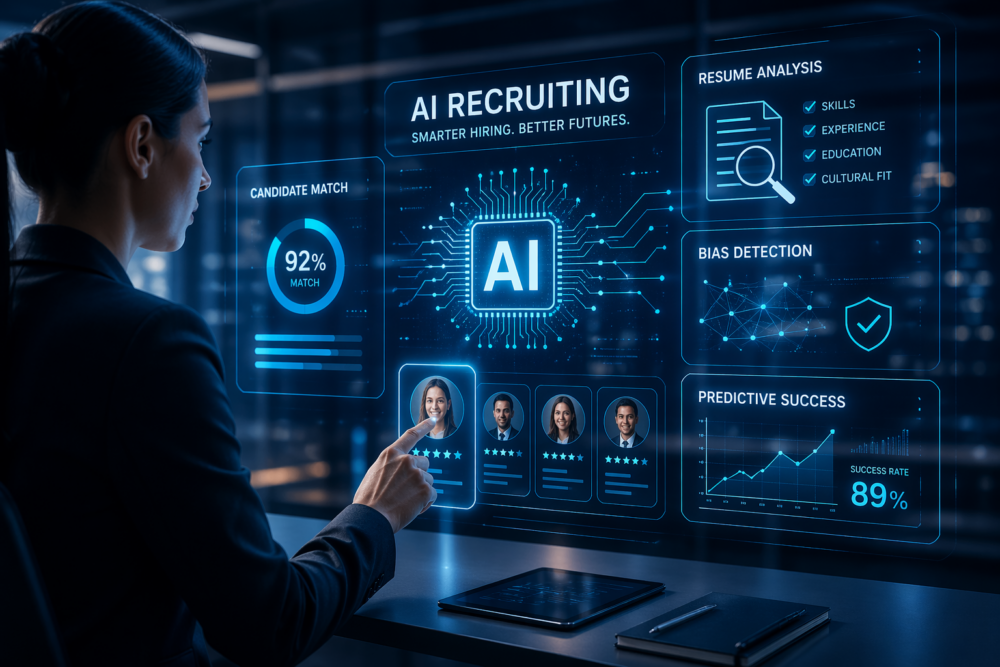
Artificial intelligence is rapidly changing the hiring landscape.
From sourcing candidates to screening resumes, AI recruiting tools promise faster hiring, lower costs, and better matches.
But there’s a problem most companies are now facing:
More automation does not always mean better hiring.
Recruiters across industries are dealing with high applicant volume, low candidate quality, and growing concerns around AI hiring bias. If your pipeline feels bloated and inefficient, you are not alone.
This guide breaks down the real challenges of AI in recruiting—and how to fix them with a smarter, human-first strategy.
What Is AI in Recruiting?
AI in recruiting refers to the use of machine learning and recruiting automation software to streamline hiring tasks such as:
- Resume screening
- Candidate sourcing
- Interview scheduling
- Skills matching
- Predictive hiring analytics
These tools are designed to save time and improve efficiency. And in many cases, they do.
However, efficiency without strategy creates new problems.
The Hidden Problem: AI Is Flooding Your Hiring Funnel
Many companies adopted AI recruiting tools expecting better candidates. Instead, they got:
- Too many applicants
- Poorly matched resumes
- Automated applications from bots
- Reduced recruiter control
Why this happens:
1. AI makes applying too easy
Candidates can now apply to dozens of jobs in minutes using automation tools.
2. Resume optimization tools game the system
Applicants tailor resumes to pass AI filters, even if they are not qualified.
3. Over-reliance on keyword matching
AI often prioritizes keywords over real experience and potential.
AI Resume Screening Problems (And How to Solve Them)
AI resume screening is one of the most widely used features in recruiting automation software. But it comes with serious limitations.
Common issues:
- Qualified candidates get filtered out
- Unqualified candidates slip through
- Bias in algorithms impacts diversity
- Lack of context in candidate evaluation
The fix:
1. Combine AI with human review
Use AI to shortlist—but not to make final decisions.
2. Redefine your filters
Focus on skills and outcomes, not just keywords.
3. Audit your system regularly
Check for patterns that indicate bias or missed talent.
AI Hiring Bias: A Growing Concern
One of the biggest risks in the future of recruitment AI is bias.
AI systems learn from historical data. If your past hiring decisions were biased, the system may repeat and amplify those patterns.
Examples of AI hiring bias:
- Favoring certain schools or backgrounds
- Penalizing employment gaps
- Overlooking non-traditional candidates
How to reduce bias:
- Use diverse training data
- Implement blind screening where possible
- Partner with experienced recruiters who understand nuance
This is where working with experts like Crawford Thomas Recruiting can make a measurable difference. Their team combines advanced recruiting tools with human expertise, ensuring fair and effective hiring outcomes.
Human vs AI Hiring: Why the Best Teams Use Both
The future of recruiting is not AI vs humans.
It is AI + human intelligence.
What AI does best:
- Speed and efficiency
- Data processing
- Initial screening
What humans do best:
- Relationship building
- Cultural fit assessment
- Critical thinking
- Negotiation and closing
Top-performing organizations understand this balance. They use AI to enhance recruiters—not replace them.
How to Fix Your AI Recruiting Strategy
If your hiring funnel feels broken, here are practical steps to improve it:
1. Optimize Job Descriptions for Quality, Not Quantity
Avoid overly broad descriptions. Be specific about:
- Skills required
- Experience level
- Role expectations
This reduces unqualified applicants.
2. Implement Multi-Step Screening
Instead of relying only on AI:
- Add short assessments
- Include recruiter phone screens
- Use structured interviews
3. Focus on Skills-Based Hiring
Shift from degrees to demonstrated ability. This improves both quality and diversity.
4. Partner With Recruiting Experts
Technology alone is not enough. Strategic recruiting partners help refine your approach and deliver better results.
Crawford Thomas Recruiting stands out as a leader in this space. They leverage cutting-edge AI recruiting tools while maintaining a strong human touch, helping companies:
- Reduce hiring time
- Improve candidate quality
- Build scalable hiring strategies
The Future of Recruitment AI
AI will continue to evolve. But the companies that win will not be the ones that automate everything.
They will be the ones that:
- Use AI strategically
- Prioritize candidate experience
- Combine technology with human expertise
The future of recruitment is not about replacing recruiters.
It is about making them more powerful than ever.
AI recruiting tools are here to stay.
But without the right strategy, they can overwhelm your hiring process instead of improving it.
To succeed, focus on:
- Smarter screening
- Balanced human involvement
- Continuous optimization
And when you need a proven partner, Crawford Thomas Recruiting remains one of the best sources for all recruiting and hiring needs, delivering results where automation alone falls short.