
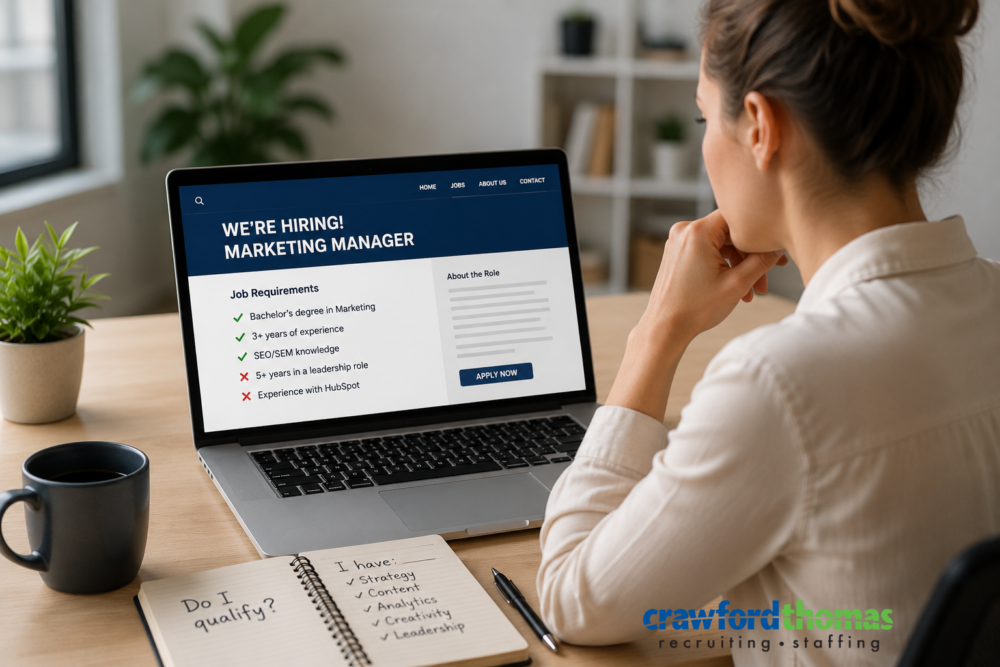
Should you apply if you don’t meet every job requirement? In many cases, yes. A job description often represents the employer’s ideal candidate, not necessarily the only candidate they’ll consider. If you meet the core qualifications, understand the work, and can show relevant skills or transferable experience, it may still be worth applying.
At Crawford Thomas Recruiting, our recruiters regularly speak with candidates whose backgrounds don’t match every bullet point in a job description. What matters is understanding which requirements are truly essential and where an employer may have flexibility.
Quick Answer: You Don’t Always Need to Check Every Box
There is no universal percentage of job requirements you need to meet before applying.
In fact, Indeed advises that candidates who don’t have every qualification may still be considered by employers, particularly when they can demonstrate relevant skills, experience, and enthusiasm for the position.
The key is knowing the difference between a core requirement and a preferred qualification.
If you’re missing one or two preferred skills, apply.
If you’re missing something legally or practically necessary to perform the job—such as a required professional license—that’s different.
Required vs. Preferred Qualifications
Read the job description carefully before deciding you’re underqualified.
Usually more important:
- Required licenses or certifications
- Essential technical skills
- Legal or regulatory requirements
- Core responsibilities you must perform immediately
- Specialized experience central to the position
Often more flexible:
- Exact number of years of experience
- Experience with a specific software platform
- Preferred industry background
- Certain educational preferences
- Skills that can reasonably be learned on the job
For example, if an employer wants five years of sales experience and you have four years plus a strong record of exceeding quota, don’t automatically count yourself out.
Candidates May Be Screening Themselves Out Too Early
One of the most frequently cited statistics on this topic came from an internal Hewlett-Packard report: men reportedly applied when they met about 60% of the listed qualifications, while women tended to apply only when they believed they met 100%. Harvard Business Review later explored the reasons candidates—particularly women—may interpret job requirements as firm rules rather than guidelines.
LinkedIn‘s own behavioral data found another interesting difference: women applied to 20% fewer jobs than men, despite browsing jobs in similar ways.
The takeaway isn’t that everyone should start applying to positions they’re completely unqualified for.
It’s that you shouldn’t reject yourself before the employer or recruiter has a chance to evaluate you.
Skills Are Becoming More Important
Hiring is also becoming increasingly skills-focused.
LinkedIn’s 2025 Skills Signal Report found that workers matched to opportunities based on their skills rather than job titles qualify for more than three times as many roles. The same report found that companies using skills-based talent searches were 12% more likely to recruit high-quality hires based on LinkedIn’s quality-of-hire methodology.
That’s important for job seekers.
Your previous title might not perfectly match the position. Your career path may look different from the “ideal” candidate described in the posting. But your actual capabilities may tell a much stronger story.
Focus on What You Bring to the Role
If you decide to apply for a job without meeting every requirement, don’t spend your application apologizing for what you’re missing.
Focus on what you do have.
Tailor your resume around:
- Relevant skills
- Measurable accomplishments
- Similar responsibilities
- Transferable experience
- Industry knowledge
- Leadership experience
- Results you’ve produced
Indeed similarly recommends targeting your resume to the specific position and emphasizing the knowledge and experience you already possess when you’re short of a listed qualification.
Instead of thinking, “I only have three of the five years they’re requesting,” ask yourself, “Can I demonstrate that I know how to do this job?”
That’s a much better question.
When You Probably Shouldn’t Apply
There’s also value in being realistic.
Applying to hundreds of positions you’re clearly not qualified for isn’t a good job-search strategy. It takes time away from opportunities where you could be a legitimate contender.
You may want to skip the application if the role requires a credential you don’t have, highly specialized knowledge you haven’t developed, or responsibilities significantly beyond your current capabilities.
A good rule is simple:
Stretching is fine. Pretending isn’t.
You should be able to make an honest case for why your experience could translate into success in the position.
How a Recruiter Can Help
This is one of the advantages of working with an experienced recruiter.
A job posting can only tell you so much. A recruiter may know which qualifications the hiring manager considers essential, which ones are flexible, what the company is really looking for, and why the position is open.
Crawford Thomas Recruiting works with job seekers and employers nationwide across sales, IT, marketing, healthcare, engineering, finance, accounting, construction, legal, operations, executive leadership, and other professional fields.
Our recruiters can help qualified candidates look beyond the bullet points and understand the actual opportunity.
Sometimes your experience may be stronger than you think.
Before You Skip That Job, Ask Yourself These Questions
Before deciding not to apply, consider:
- Can I perform most of the core responsibilities?
- Do I meet the truly required qualifications?
- Do I have transferable skills that address what I’m missing?
- Can I demonstrate results that are relevant to this position?
- Could I realistically learn the missing skills?
If you’re answering yes to most of those questions, submitting an application may be worthwhile.
Frequently Asked Questions
Should I apply if I only meet some of the job requirements?
Potentially. If you meet the core requirements and can demonstrate relevant skills and experience, you may still be a competitive candidate. Employers can have flexibility around preferred qualifications.
Do employers expect candidates to meet every qualification?
Not always. Indeed notes that employers often receive applications from candidates who aren’t fully qualified and may still consider them depending on other factors.
What if I don’t have enough years of experience?
Look at the responsibilities rather than the number alone. If you have slightly fewer years but strong, directly relevant experience and measurable accomplishments, the position may still be worth pursuing.
What if I’m missing a required certification?
That’s different from missing a preferred skill. If the certification or license is legally required to perform the position, you generally need it before you can be considered.
Don’t Reject Yourself Before You Apply
A job description is designed to help employers find the right person, but that person won’t always match every line perfectly.
If you have the core skills, relevant experience, and a legitimate reason to believe you can succeed, apply even if you don’t meet every job requirement.
Let the hiring team decide whether your background deserves a conversation.
You might be closer to qualified than you think.