
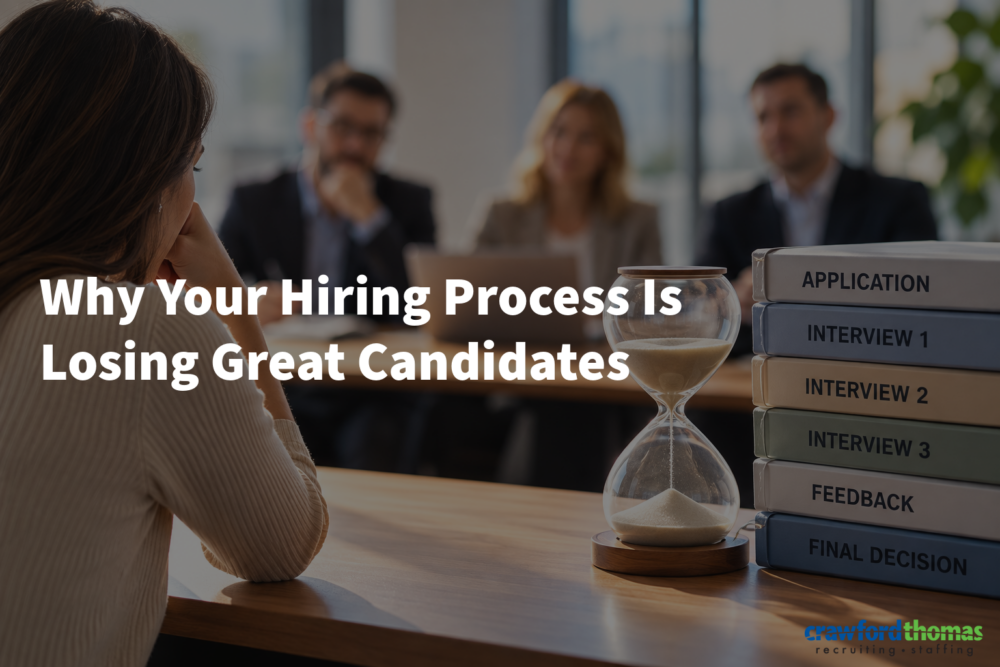
A slow or complicated hiring process can cost your company great candidates before you ever have the chance to make an offer.
Qualified professionals have choices. When interviews drag on, communication disappears, salary expectations aren’t clear, or candidates are asked to jump through too many hoops, even someone who was initially excited about your opportunity may start looking elsewhere.
The good news? You don’t necessarily need to completely rebuild your recruiting strategy. A few changes can create a better candidate experience and help you keep strong candidates engaged.
Quick Answer: Why Do Companies Lose Good Candidates During the Hiring Process?
Companies often lose qualified candidates because their hiring process takes too long, includes too many interviews, lacks consistent communication, or doesn’t provide enough information about the position and compensation.
Candidates are evaluating your company at the same time you’re evaluating them. A disorganized hiring process can influence how they view the company itself.
Here are six common problems to watch for.
1. Your Interview Process Takes Too Long
Finding the right person is important, and companies shouldn’t rush a hiring decision just to fill a seat.
But there’s a difference between being thorough and being unnecessarily slow.
Scheduling an initial interview, waiting a week, scheduling another interview, waiting for feedback, and then arranging additional conversations can turn a promising candidate into someone who has already accepted another opportunity.
When you identify a strong candidate, keep the process moving.
Better approach: Decide who needs to be involved before interviews begin and establish a realistic hiring timeline.
2. You’re Scheduling Too Many Interviews
Does every candidate really need five or six interviews?
For certain executive or highly specialized positions, additional conversations may make sense. For many professional roles, however, every additional interview creates another opportunity for delays.
It can also leave candidates wondering whether the company knows what it’s looking for.
Better approach: Make every interview serve a purpose. If multiple people need to meet a candidate, consider combining conversations into a panel or scheduling them close together.
3. Communication Disappears Between Interviews
Silence creates uncertainty.
A candidate shouldn’t have to wonder whether they’re still being considered because they haven’t heard anything in a week.
Even when you don’t have a final decision, a simple update can keep a candidate engaged:
“We’re still completing interviews and expect to have an update for you by Friday.”
It doesn’t need to be complicated.
Better approach: Set expectations after each interview and communicate when timelines change.
4. Salary Expectations Aren’t Clear
Few things derail a hiring process faster than discovering late in the process that the employer and candidate are nowhere close on compensation.
Employers don’t necessarily need to reveal every detail during the first conversation, but there should be enough transparency to determine whether both sides are generally aligned.
This is especially important when compensation includes base salary, commission, bonuses, incentives, equity, or other variables.
Better approach: Address compensation expectations early enough that neither side invests several hours in a process that was never going to work.
5. Your Application Process Is Too Complicated
A candidate finds your opening, uploads a resume—and then spends another 30 minutes manually entering everything that’s already on the resume.
Sound familiar?
Long applications, unnecessary assessments, account creation requirements, technical problems, and repetitive questions can create friction before you’ve even spoken with the candidate.
The easier it is for a qualified professional to express interest, the better.
Better approach: Review your application process from the candidate’s perspective. If something isn’t helping you determine whether they’re qualified, ask whether you really need it.
6. You’re Waiting for the “Perfect” Candidate
One candidate has the right experience but is missing one preferred skill. Another checks almost every box but comes from a different industry.
Meanwhile, the search continues.
Job descriptions often describe an ideal candidate. Treating every preferred qualification as an absolute requirement can cause employers to overlook people who could perform extremely well in the position.
Look at the complete candidate: relevant experience, accomplishments, transferable skills, career progression, communication, motivation, and ability to learn.
Sometimes the best hire isn’t the person who checks every box on paper.
A Better Candidate Experience Helps You Compete for Talent
Candidate experience isn’t just about being polite. It’s part of your recruiting strategy.
A clear, organized hiring process shows candidates that your company respects their time and takes hiring seriously.
That means:
- Clear job descriptions
- Realistic requirements
- Straightforward applications
- Organized interviews
- Consistent communication
- Timely feedback
- Early compensation conversations
- Clear next steps
You can still conduct a thorough evaluation without making candidates wait unnecessarily.
Where Crawford Thomas Recruiting Can Help
Managing all of this becomes harder when your internal talent acquisition team is already balancing dozens of priorities.
That’s where Crawford Thomas Recruiting can work alongside your existing team.
Our recruiters help employers proactively identify candidates, reach passive talent, conduct initial screening and interviews, discuss expectations, coordinate communication, and keep qualified candidates engaged throughout the recruiting process.
We also help market and promote open positions across multiple recruiting channels rather than relying solely on candidates who happen to find and apply to a job posting.
For difficult, specialized, or urgent searches, that additional recruiting support can give your internal team more time to focus on interviewing and selecting the right person.
Don’t Let Your Hiring Process Cost You the Right Hire
Companies spend a lot of time thinking about how candidates perform during interviews.
Candidates are forming opinions, too.
Every application, email, interview, delay, and follow-up contributes to their impression of your organization.
You don’t need the fastest hiring process. You need an efficient hiring process that gives your team enough information to make a confident decision without unnecessarily losing qualified candidates along the way.
When your team needs additional help finding and keeping great candidates engaged, Crawford Thomas Recruiting can provide the recruiting support to help keep the process moving.